Showing posts with label Wascana. Show all posts

Wednesday, November 30, 2016

Brewer's Blackbirds: Iridescent with brilliant eyes

It's a delight to see a male Brewer's Blackbird in full sunlight — I usually see these birds as only black shapes with glowing eyes, high in the trees at Wascana Park. But when they are well lit, these birds glisten with shimmering iridescence. And those eyes! Those bright, shining yellow eyes.

Male Brewer's Blackbird. Copyright © Shelley Banks, all rights reserved
Male Brewer's Blackbird, strutting across Wascana Park, in Regina, SK  © SB

The females, however, are somewhat less brilliant, both in feathers and eyes, which in the case of the female Brewer's Blackbird I saw with the flashy guy above, were both dull brown.

Female Brewer's Blackbird. Copyright © Shelley Banks, all rights reserved
 Female Brewer's Blackbird in Wascana Park, Regina, SK   © SB

What are these? Brewer's Blackbirds (Quiscale de Brewer) 
Location: Wascana Park, Regina, Saskatchewan
Photo date: May 4, 2012.

~~~~~

Thursday, November 24, 2016

Gray Catbird along Wascana Creek in Regina SK

Gray Catbird. Copyright © Shelley Banks, all rights reserved
Gray Catbird, singing its hoarse cat-like song. © SB

During one of my regular, but long-ago, walks along Wascana Creek, I saw a Gray Catbird.

I understand that they're not uncommon in Regina, SK, in the summer, but this is one of the few I've photographed so far.

These mid-sized birds have an overall gray colouring, with black caps and dark reddish orange under-tail feathers.

(The picture below shows a better view of these rufous feathers. In that shot, this bird looks paler, too — a trick of harsh light in deep shadow, I suspect.)

Although they sometimes mimic other birds, the Gray Catbird's standard song is an odd, cat-like mewling.

This one stayed firmly in the shade of nearby trees, as if determined to thwart me and my camera-clutching hands.

(It would be nice if birds didn't do that... I would have liked a closer look at this Gray Catbird!)

Gray Catbird. Copyright © Shelley Banks, all rights reserved
Gray Catbird, along Wascana Creek, Regina. © SB

What is this? Gray Catbird (Moqueur chat)
Location: Wascana Creek, Regina, Saskatchewan
Photo date: July 6, 2012.

~~~~~

Sunday, September 11, 2016

Mud-digging Northern Flickers: Wascana Park, Regina

I've always thought of Northern Flickers as tree birds not ground birds, bark drillers not dirt diggers. But when I watched several Flickers in Regina's Wascana Park on Friday, these large brown woodpeckers were spending far more time in the mud than in the trees. (And even those on the trees had muddy beaks to show that they, too, had been digging. Or they'd just finished scraping their beaks against the bark, to get them clean.) 

Northern Flicker (yellow shafted). Copyright © Shelley Banks, All Rights Reserved.
Northern Flicker, taking a break from dirt drilling.  © SB 

Northern Flicker (yellow shafted). Copyright © Shelley Banks, All Rights Reserved.
Northern Flicker resting on a tree, with muddy beak.
The line of yellow wing feathers is also visible.  © SB

Northern Flicker (yellow shafted). Copyright © Shelley Banks, All Rights Reserved.
Blurred, but shows the colour of these
Northern Flickers' feather shafts. © SB

What is this? A Northern Flicker (yellow-shafted); or Pic flamboyant 
Location: Wascana Park, Regina, Saskatchewan
Photo date: September 9, 2016.

~~~~~

Wednesday, July 20, 2016

Yellow-bellied Sapsucker: bright red throat and head

Always seems strange to me that the Yellow-bellied Sapsucker's most arresting markings — its throat and head — are not yellow at all, but red. And yes, I know, this name distinguishes them from other kinds of Sapsuckers. But still...

Somewhere on the belly of this bird, there are yellow feathers.
Yellow-bellied Sapsucker, Wascana Park, Regina. © SB

What is this? A Yellow-bellied Sapsucker
Location: Wascana Park, Regina, Saskatchewan, Canada
Photo date: April 25, 2016

~~~~~

Thursday, June 23, 2016

Four Amigos: Snow Geese on Wascana Lake

Four Snow Geese, Wascana Lake. Copyright © Shelley Banks, all rights reserved.
The four friends crossing Wascana Lake to the park near the museum   © SB
Every spring and fall, thousands of Snow Geese fly over Regina, SK, on their way north to the Arctic to breed.

This year, four have landed to spend the summer in Wascana Park, where they can be seen on and around Spruce Island, and other parts of the park.

I don't know why they stayed... Maybe one was hurt? Maybe they all realized that the picking here were good.

Whatever the reason, they seem relatively tame, and it was fun to see them up close, and to try for detailed pictures showing their feathers and faces — especially that gaping black "grin patch" (All About Birds) on their stubby pink bills.

Snow Goose, Wascana Lake. Copyright © Shelley Banks, all rights reserved.
Snow Goose, posing on the north shore of Wascana Lake.  © SB
Snow Goose, Wascana Lake. Copyright © Shelley Banks, all rights reserved.
Snow Goose in action! © SB
Four Snow Geese, Wascana Lake. Copyright © Shelley Banks, all rights reserved.
Snow Goose crossing... With Canada Geese in the background.  © SB
Snow Goose, Wascana Lake. Copyright © Shelley Banks, all rights reserved.
Snow Goose swimming back across the lake.  © SB

What are these?  Snow Geese (Harfang des neiges) 
Location: Wascana Park, Downtown Regina, Saskatchewan. 
Photo date: May 19, 2016

~~~~~

Friday, June 3, 2016

Thirteen-lined Ground Squirrel at Wascana Park, Regina

Perhaps I'm the only one who thinks that Thirteen-Lined Grounds Squirrels are amazingly cute creatures. What could be better than stripes and spots, and a name that's almost longer than their own tiny bodies?

Thirteen-lined Ground Squirrel. Copyright © Shelley Banks, all rights reserved.
Thirteen-lined Ground Squirrel, so named
for the alternating dark and light bands on their backs. © SB

I've seen them standing at the sides of our roads, and even watched them carry babies across. (Now those must be teeny!) But watching Thirteen-Lined Ground Squirrels eat is always intriguing. And no, I have no idea what this fellow is holding. I know only that he was shoving it into his mouth when he first noticed me — or I first noticed him — and then he removed it. But these creatures are said to be omnivores, so who knows?

I noticed this Thirteen-lined Ground Squirrel in the Habitat Conservation area at Wascana Park during the May 2016 Wings Over Wascana Day. He was very close to my path, and stood very still while I took a few pictures — until a guy explaining a nearby water hose to his kid scared this little rodent away.

I wonder: Would the kid have liked to see him? I doubt they even realized he was there.

Slow down. Be quiet. Watch and listen.


What is this? A Thirteen-lined Ground Squirrel
Location: Wascana Habitat Conservation Area, Wascana Marsh/Park/Bird Sanctuary, Regina, Saskatchewan, Canada
Photo date: May 28, 2016
~~~~~

Tuesday, May 31, 2016

Franklin's Gull in Flight Over Wascana Lake, Regina

Because it makes me happy when my camera captures detailed shots of flying birds, here are three images of a Franklin's Gull in flight over Wascana Lake, on the bird sanctuary side. 

Franklin's Gull. Copyright © Shelley Banks, all rights reserved.
Franklin's Gull, wings high over Wascana Lake, Regina, SK  © SB 
Franklin's Gull. Copyright © Shelley Banks, all rights reserved.
Franklin's Gull crying over the lake.  © SB
Franklin's Gull. Copyright © Shelley Banks, all rights reserved.
Franklin's Gull, black-tipped gray and white wings flapping.  © SB

What are these? Franklin's Gull — Mouette de Franklin.
Location: Wascana Lake, Saskatchewan
Photo date: April 26, 2016.

~~~~~

Sunday, May 29, 2016

Yellow Warblers in the Wascana Habitat Conservation Area

The Wings over Wascana nature festival was held in Regina, SK, this weekend, and as I walked around the Habitat Conservation Area. I was surprised by how many Yellow Warblers were enjoying the marsh.

Yellow Warbler. Copyright © Shelley Banks, all rights reserved.
Male Yellow Warbler, singing beside Wascana Lake,
in the Habitat Conservation Area.  © SB

I'm getting to know the Yellow Warblers' sweet, chipping calls after hearing them in other parts of Wascana Park — and I love seeing their flashes of gold in the trees. (We even had one late evening in our backyard a couple of weeks ago.) And in the marsh, I was lucky to be able to watch a female Yellow Warbler build her nest!

Volunteers were banding birds, so it was very cool to later see a Yellow Warbler with a band on his leg. (You can see the band on the bird's right leg, close to the foot, visible just behind the branch...)

Yellow Warbler. Copyright © Shelley Banks, all rights reserved.
A banded male Yellow Warbler, in Wascana Park, Regina, SK   ©SB

What are these? Yellow Warblers - Paruline jaune
Location: Wascana Habitat Conservation Area, Wascana Marsh/Park/Bird Sanctuary, Regina, Saskatchewan, Canada
Photo date: May 28, 2016

~~~~~
   

Saturday, May 28, 2016

White-breasted Nuthatch at Wascana Park Regina SK

White-breasted Nuthatch. Copyright © Shelley Banks, all rights reserved.
White-breasted Nuthatch,
with gray and black and white chest. © SB
I'd seen White-breasted Nuthatches before, but so briefly that my camera couldn't catch them, and I wasn't sure whether they were real or imagined.

Finally, this month, I was able to watch one long enough to know that yes, it was indeed a White-breasted Nuthatch — a bird I gather is fairly common in many parts of North America, but not so common (in my experience, at least) here.

To my eyes, the White-breasted Nuthatch is quite a bit larger than the Red-breasted ones I'm more familiar with. Still a small bird, though. And one that still sports the typical nuthatch pose.

White-breasted Nuthatch. Copyright © Shelley Banks, all rights reserved.
White-breasted Nuthatch, in upturned Nuthatch pose. © SB 

What is this? A White-breasted Nuthatch
Location: Near the swimming pool in Wascana Park, Regina, Saskatchewan, Canada
Photo date: May 19, 2016

~~~~~

Sunday, May 8, 2016

Black-headed gull #2: Franklin's Gull at Chaplin and Wascana

Franklin's Gull. Copyright © Shelley Banks, all rights reserved
Franklin's Gull, near Chaplin, SK  © SB 
I first saw a Franklin's Gull several years ago at the edge of a lake near Chaplin, Saskatchewan, part of the Western Hemispheric Shorebird Reserve Network site.

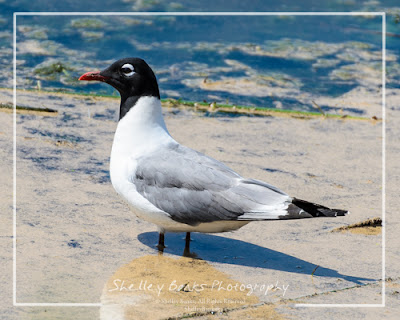
With its clown-wide white eye-rings, bright orange bill, black head and white chest, Franklin's Gull is an unforgettably striking bird of contrasts.

And yet, when I saw Franklin's Gulls far out on Wascana Lake last week, I had difficultly at first distinguishing them from another black-headed gull, Bonaparte's Gull.

(Note to self: Carry binoculars. The differences were clear through the telephoto viewfinder, and on the computer at home. Although also small, Franklin's Gull seemed a little larger than Bonaparte's, but more critically for me, the Franklin's Gull's beak is orange, not black; its white eye-rings are more startlingly large; the black feathers creep further down its neck; its wing feathers are a darker gray — and no Franklin's Gulls that I saw had feathers that ruffled in the wind.)

Franklin's Gull. Copyright © Shelley Banks, all rights reserved
Franklin's Gull, overcast day, Wascana Lake, Regina, SK  © SB

Named for the Arctic explorer, Franklin's Gull nests on the Prairies, aka the Northern Great Plains, and Audubon.org says it's sometimes called the "Prairie Dove." (Audubon also labels it as "Climate Threatened.") As for their winters, these "highly migratory" birds spend those along the west coast of South America.


What are these? Franklin's Gull — Mouette de Franklin.
Location: Near Chaplin, and at Wascana Lake, Saskatchewan
Photo date: June 29, 2012, and April 26, 2016.


~~~~~

Saturday, May 7, 2016

Black-headed gull #1: Bonaparte's Gull on Wascana Lake

Bonaparte's Gull. Copyright © Shelley Banks, all rights reserved
Bonaparte's Gull, Wascana Lake, Regina, SK  © SB
Several days ago, I saw two species of black-headed gulls on Regina's Wascana Lake.

Today, pictures of the smaller one, Bonaparte's Gull. (Pix to follow of Franklin's Gull.)

Bonaparte's Gull is a sleek bird with a black beak, black head and tail feathers, soft gray wings, bright white eye-rings — and, from what I saw on the lake, feathers that ruffle in the wind.

Bonaparte's Gull winters in the southern and coastal U.S. and the Caribbean, and spends its summer breeding season in Alaska and northern Canada.

It also — says All About Birds — has the unusual practice of nesting not on the ground, but in trees.

Bonaparte's Gull. Copyright © Shelley Banks, all rights reserved
Bonaparte's Gull, described as a small, delicate gull.   © SB

Audubon.org calls it the smallest gull usually seen in North America, and describes Bonaparte's as delicate, and tern-like in flight. (I'd like to say that I personally noticed both of these things... However, while I could see that it was smaller than the Franklin's Gulls and large Ring-billed Gulls also on the lake, it was a very long way out across the water...

As for the name, Aududon says Bonaparte's Gull honors French zoologist Charles Lucien Bonaparte, a distant cousin of Napoleon. 


What are these? Bonaparte's Gull — Mouette de Bonaparte.
Location: Wascana Lake, Regina, Saskatchewan
Photo date: April 28, 2016.

~~~~~

Thursday, May 5, 2016

Wood Ducks: Brilliant Camouflage on Wascana Lake

Wood Duck. Copyright © Shelley Banks, all rights reserved
Wood Duck on Wascana Lake, Regina, SK   © SB
I never realized how well the markings of Wood Ducks help them hide until I saw and photographed several recently on Wascana Lake.

(And yes, there are Wood Ducks in Regina, SK, and they appear to be doing very well.)

As I watched, the Wood Ducks swam along the edge of an island in the bird sanctuary, dodging deadfalls and other waterbirds.

Seen through my zoom lens, the colours of the male were brilliant and eye-catching; seen by eye against the shore, his high-contrast colouring blended with shaded roots and sunlit branches, and he easily slipped out of sight. The same happened with the female Wood Duck's soft brown, white and blue feathers when she swam across a stretch of water. Hiding in plain view — what a trick!

In all, I saw four males and one female, though there may have been more females in the group... From far away, it's difficult to distinguish a female Wood Duck from any other brown-streaked duck, and so I only counted the obvious one.    

Female Wood Duck. Copyright © Shelley Banks, all rights reserved
Female Wood Duck, colours blending into the changing shades of the water. © SB
Male Wood Duck. Copyright © Shelley Banks, all rights reserved
Male Wood Duck, hiding in plain sight again deadfalls.
(Sure, he's easy to see in a close-up - but not from a distance.)   © SB
Wood Ducks. Copyright © Shelley Banks, all rights reserved
Pair of Wood Ducks on Wascana Lake, Regina, SK.  © SB

What are these? Wood Ducks — Canard branchu
Location: Wascana Lake, Regina, Saskatchewan
Photo date: April 28, 2016.

~~~~~

Wednesday, May 4, 2016

Red-breasted Mergansers on Wascana Lake, Regina

Red-breasted Mergansers. Copyright © Shelley Banks, all rights reserved.
Red-breasted Mergansers on Wascana Lake.  © SB
In the distance, I saw a pair of Mergansers, recognizable by their long, low outline.

Through the camera, I realized these sleek, bad-hair-day birds were new to me, and later discovered they were Red-breasted Mergansers. (Not Common, as I'd thought.)

The Red-breasted Merganser winters along the coasts of North America, migrates across the interior, and breeds in summer in the north.

Apparently, they like salt water, but this pair seemed happy in our local man-made Wascana Lake.
 
Male Red-breasted Merganser. Copyright © Shelley Banks, all rights reserved.
Male Red-breasted Merganser. © SB
Female Red-breasted Merganser. Copyright © Shelley Banks, all rights reserved.
Female Red-breasted Merganser. © SB


What are these? Red-breasted Mergansers — Harle huppé
Location: Wascana Lake, Regina, Saskatchewan
Photo date: April 27, 2016.

~~~~~

Friday, April 29, 2016

Greater White-Fronted Goose in Wascana Lake

Greater White-fronted Goose. Copyright © Shelley Banks, all rights reserved.
Greater White-fronted Goose, Wascana Lake Bird Sanctuary, Regina. 
When I strolled along Wascana Lake, a Greater White-fronted Goose kept me company for a while, paddling beside the path.

The markings on these brown and white geese are both subtle and striking.

Contrasted against the soft brown feathers on its body, its orange bill and white face feathers make it look slightly clown-like to me, a reference unlikely to please this grumpy-looking goose. (I'm sure all geese are very happy, but to me, they generally look 'out of sorts,' as my mother use to say.)

All About Birds says Greater White-fronted Geese have one of the largest ranges of any species of goose in the world, but they are common in North America only west of the Mississippi in wetlands and fields.

They seem to be a frequent visitor at this time of year to Saskatchewan. I've seen them several times at Wascana Lake in Regina, and also in the lakes along the TransCanada Highway near Chaplin and Morse, stopping off on their way north to the tundra.

Greater White-fronted Goose. Copyright © Shelley Banks, all rights reserved.
Greater White-Fronted Goose at Wascana Lake, Regina, SK © SB
Greater White-fronted Goose. Copyright © Shelley Banks, all rights reserved.
Head-on, the origin of the goose's White-fronted name is clear. © SB

What is this? Greater White-fronted Goose — Oie rieuse.
Location: Wascana Lake, Regina, Saskatchewan
Photo date: April 25, 2016.

~~~~~

Tuesday, April 26, 2016

Ruby-crowned Kinglets in Wascana Park, Regina

Ruby-crowned Kinglet. Copyright © Shelley Banks, all rights reserved.
Ruby-crowned Kinglet, Regina, SK  © SB
Ruby-crowned Kinglets fluttered through the bushes along the edge of the water at Wascana Park, their heads lit by a red flame.

These tiny birds (smaller than a warbler or chickadee) have a lovely trick of hiding — or flashing — their bright crown feathers.

At least, the males do; sometimes their ruby crown is visible, and sometimes it's not. (And, from the bird books, sometimes it's far more flashy than shown here.)

Sometimes, too, a Ruby-crowned Kinglet itself would be visible for me...

However, during most of the time I stood watching them, they dove and wove through low stalks, keeping twigs and branches between themselves and my camera, with only an occasional flash of red confirming their presence.

And I have many shots of their tails and backs, or the tips of their beaks peeking out, their rest of their chubby bodies and greenish-buff feathers hidden behind grey branches.

Spring — what fun!

Ruby-crowned Kinglet. Copyright © Shelley Banks, all rights reserved.
Ruby-crowned Kinglet, Wascana Park, Regina. © SB

What are these? Ruby-crowned KingletsRoitelet à couronne rubis
Location: Wascana Park, beyond the Connexus Centre, Regina, Saskatchewan, Canada 
Photo dates: April 25, 2016.

~~~~~

Thursday, May 16, 2013

Yellow-rumped Warbler - my bandit bird is back!

Yellow-rumped Warblers make me think of bandits in old black and white TV shows — dashing Zorro-like outlaws, wearing black masks.

But the clearest identifying mark on Yellow-rumped Warblers is not, of course, their facial marking, but those vibrant flashes of yellow on their chest and — most of all — their rumps. An apt name.

Here's my first Yellow-rumped Warbler of  2013, in the bushes by Wascana Lake, east of Broad Street, in Regina, Saskatchewan.

Yellow-rumped Warbler. Photo  © Shelley Banks, all rights reserved.
Yellow-rumped Warbler, Regina, Saskatchewan.   © SB

What is this? A Yellow-rumped Warbler
Location: East section of Wascana Lake, Regina, Saskatchewan, Canada.  
Photo date: May 15, 2013.

~~~~~

Sunday, July 29, 2012

Downy Woodpecker Drilling at my Window Ledge

A rat-tat-tat-tat from the window caught my attention. I looked up to see a Downy Woodpecker on the windowsill, his beak busy drilling at the ledge.

By the time I got outside to take his picture, he'd flown from the house to the crab apple, and then to the tree by the road.  (He = male = yes. You can tell by the red spot at the back of his head.) 

The Downy Woodpecker who was at
my home office window. © SB

Several weeks ago, I saw a female Downy Woodpecker, and had a slightly better chance to capture her feathers and markings.

Female Downy Woodpecker - no red spot.  ©  SB

What are these birds? Downy Woodpeckers
Location: Male: Front yard, Regina, Saskatchewan. Female: Wascana Park, Regina, Saskatchewan. 
Photo dates:  Male: July 26, 2012. Female: May 25, 2012. 

~~~~~

Monday, July 9, 2012

Western Painted Turtle in Wascana Creek

Regina, Saskatchewan: A wildlife treat at lunch today — a Western Painted Turtle swimming in Wascana Creek. These pictures of this colourful, long-clawed prairie turtle are taken from the little bridge not far from Albert Street.

This turtle looked about a foot long, and was completely invisible once submerged in the algae in Wascana Creek.  (The bits of algae are sharp in the images; without my telephoto lens, they blurred to solid green.)

For more about these turtles  and a glimpse at their wonderful painted lower  see the Western Painted Turtle post from earlier this spring, when I located the spot in Regina where they like to sun.

(And yes, for the record, I still love their name: Chrysemys picta bellii. Bella belly, indeed!) 


Western Painted Turtle in Wascana Creek
  check out the claws!   © SB
Verde, que te quiero verde... Verde agua...
How green can it get! And the turtle, too. © SB


What is this? Painted TurtleChrysemys picta bellii
Location: Wascana Creek (west of the Albert Street Bridge), Regina, Saskatchewan.
Photo date: July 9, 2012.  

~~~~~

Sunday, July 8, 2012

Orange Skipper Butterflies on Purple Flowers

Skipper butterfly feeding on flowers
(Note the long proboscis sipping)  © SB 
Tiny skipper butterflies fed on wildflowers and rested in the grass beside Wascana Creek in Regina last week.

Skippers as a group are easy to identify because their furry bodies are so large in proportion to their wings, at least compared to many other butterflies.

They are also very small — overall, these butterflies are less than an inch long. They were tricky to snap pictures of because they rarely paused long as they skipped from blossom to blossom.

There are many different kinds of skippers, and I'm not really sure what kind sips from our Regina flowers. 

However, the dark rim and markings on their wings look like Delaware Skippers. (Here's their range map, and yes, it includes Saskatchewan.) Perhaps someone who knows will comment here. 

Skipper butterfly on a stalk of grass  © SB
Top view, Skipper butterfly   © SB

What are these?  Skipper butterflies on alfalfa or wild purple vetch. (Perhaps Delaware Skippers.) 
Location: Along Wascana Creek, Regina, Saskatchewan, Canada.
Photo date: July 5 and 6, 2012.  

~~~~~

Wednesday, May 23, 2012

Western Painted Turtles at Wascana Lake

Hi, I'm a Western Painted Turtle - who are you?  © SB
When the Friends of Wascana Marsh held an outdoor nature festival in Wascana Park a couple of weeks ago, one highlight for me was the chance to see Western Painted Turtles on the shallow shore and mud along the edge of the lake.

Online images of Western Painted Turtles often show a tiny human hand holding an even tinier turtle.

But these guys were in the wild, far from hands and fingers, and looked about a foot long. (Sources say perhaps 10 inches; I had no ruler. They may be right.)

The scientific name for these beauties is Chrysemys picta bellii — chryso, from Greek for gold, and emys, for the same for freshwater tortoise. Picta? That's easy: Painted, or Latin for coloured. 

And while I really wanted bellii to refer to these Western Painted Turtles' very bella bellies, I was surprised (or do I mean, disappointed?) to learn that instead of beautiful, bellii apparently refers instead to zoologist Thomas Bell, a collaborator of Charles Darwin's. 

Hmm... I think I prefer my etymology... Or we could rename with a word merge: 

Chrysemys picta bella belly bellii. 

By any name, beautiful. But, like so much of life, only beautiful when you stop and look. First, you have to know that the turtles are there (and not carelessly destroy their habitat). Then, you have to look beyond their dull, sun-glazed upper shells to see the amazing markings of their skin and undersides.     

Group of Western Painted Turtles sunning on the west side
of the water, Wascana Lake 
© SB  

Side view, Western Painted Turtle.   © SB  

What are these?  Western Painted TurtleChrysemys picta bellii
Location: Wascana Marsh (the enclosed area, beside the lake), Regina, Saskatchewan.
Photo date: May 12, 2012.  

~~~~~

Related Posts Plugin for WordPress, Blogger...