Showing posts with label Saskatchewan. Show all posts

Thursday, December 8, 2016

Cackling Goose - Like Canada, but Smaller

When Cackling Geese landed on the waterfowl display pond in Regina's Wascana Park recently, I thought they were Canada Geese. But when they swam closer, I realized that despite the similar markings, they looked quite different. Not only were they much smaller — closer to duck-sized — but they had rounded heads, with steeply sloped foreheads and small triangular beaks. Kind of stub-faced, in fact.

Cackling Goose. Copyright © Shelley Banks, All Rights Reserved.
Small Cackling Goose in Regina, SK  © SB 

The Cackling Goose used to be a sub-species of the Canada Goose, but it's now recognized as genetically distinct, and as a separate species that in summer flies far further north to breed. We get them here during migration, as we're on their flyway from their winter grounds.  

For comparison, here's a large, long-billed Canada Goose that was patrolling its territory in the same park, where some of its species live year-long.

Canada Goose. Copyright © Shelley Banks, all rights reserved.
Large Canada Goose in Regina, SK.  © SB

What is this? A Cackling Goose (Bernache de Hutchins), and a Canada Goose (Bernache du Canada).
Location: Wascana Park, Regina, SK
Photo dates: Cackling Goose: September 29, 2016; Canada Goose: April 26, 2016.

~~~~~

Wednesday, November 30, 2016

Brewer's Blackbirds: Iridescent with brilliant eyes

It's a delight to see a male Brewer's Blackbird in full sunlight — I usually see these birds as only black shapes with glowing eyes, high in the trees at Wascana Park. But when they are well lit, these birds glisten with shimmering iridescence. And those eyes! Those bright, shining yellow eyes.

Male Brewer's Blackbird. Copyright © Shelley Banks, all rights reserved
Male Brewer's Blackbird, strutting across Wascana Park, in Regina, SK  © SB

The females, however, are somewhat less brilliant, both in feathers and eyes, which in the case of the female Brewer's Blackbird I saw with the flashy guy above, were both dull brown.

Female Brewer's Blackbird. Copyright © Shelley Banks, all rights reserved
 Female Brewer's Blackbird in Wascana Park, Regina, SK   © SB

What are these? Brewer's Blackbirds (Quiscale de Brewer) 
Location: Wascana Park, Regina, Saskatchewan
Photo date: May 4, 2012.

~~~~~

Thursday, November 24, 2016

Gray Catbird along Wascana Creek in Regina SK

Gray Catbird. Copyright © Shelley Banks, all rights reserved
Gray Catbird, singing its hoarse cat-like song. © SB

During one of my regular, but long-ago, walks along Wascana Creek, I saw a Gray Catbird.

I understand that they're not uncommon in Regina, SK, in the summer, but this is one of the few I've photographed so far.

These mid-sized birds have an overall gray colouring, with black caps and dark reddish orange under-tail feathers.

(The picture below shows a better view of these rufous feathers. In that shot, this bird looks paler, too — a trick of harsh light in deep shadow, I suspect.)

Although they sometimes mimic other birds, the Gray Catbird's standard song is an odd, cat-like mewling.

This one stayed firmly in the shade of nearby trees, as if determined to thwart me and my camera-clutching hands.

(It would be nice if birds didn't do that... I would have liked a closer look at this Gray Catbird!)

Gray Catbird. Copyright © Shelley Banks, all rights reserved
Gray Catbird, along Wascana Creek, Regina. © SB

What is this? Gray Catbird (Moqueur chat)
Location: Wascana Creek, Regina, Saskatchewan
Photo date: July 6, 2012.

~~~~~

Wednesday, November 16, 2016

Flycatchers - Alder or Willow - Regina SK

What I know is that this little bird is a Flycatcher. I've been told it's a Traill's Flycatcher, a former species now divided in two — the more northern Alder Flycatchers and more southern Willow Flycatchers. (In terms of the North American continent, that is.)

Alder Flycatcher (or Willow Flycatcher). Copyright © Shelley Banks, all rights reserved.
A Flycatcher in Regina, SK.
Thoughts on this being an Alder Flycatcher?  © SB

As Flycatchers are very difficult to tell apart unless you know the species well, get a close look, and hear them sing, I will leave this bird ID at that. A Flycatcher. Maybe Willow, although in our part of Saskatchewan, perhaps more likely to be an Alder Flycatcher. Whatever it was, I appreciated the visit and chance to photograph this little backyard bird. 

Alder Flycatcher (or Willow Flycatcher). Copyright © Shelley Banks, all rights reserved.
Beautiful long wings and soft colours
on this little (Alder? Willow?) Flycatcher.    © SB

What is this? A Flycatcher — perhaps an Alder Flycatcher (Moucherolle des aulnes). Or if not, a Willow Flycatcher (Moucherolle des saules.)
Location: Backyard, Regina, Saskatchewan
Photo date: May 19, 2012

~~~~~

Sunday, November 13, 2016

Golden-crowned Kinglet at AE Wilson Park

I was lucky — or perhaps not, given the quality of the photograph — to catch a picture of a Golden-crowned Kinglet in the underbrush at Regina's A.E. Wilson Park this month. It was with a group of other small birds, but so much smaller. It was also flitting quickly, in deep shade...

Golden-crowned Kinglet.
(I hope my luck with this species improves!)  © SB

What is this? Golden-crowned Kinglet (Roitelet à couronne dorée)
Location: A.E. Wilson Park, Regina, SK
Photo date: Nov. 6, 2016 

~~~~~

Wednesday, November 9, 2016

Swainson's Thrush: Rare backyard Regina visitor

Swainson's Thrush is a rare backyard visitor for me in Regina, SK. In fact, I've only seen one, and that was a few years ago. This small, gray-brown secretive bird with pale spectacle marks from its eye to its beak landed in the lilac hedge one May morning, pecked under its shelter for a while, then disappeared. (Which always makes me wonder how many other one-time birds I miss...)

Swainson's Thrush. Copyright © Shelley Banks, all rights reserved.
Swainson's Thrush, backyard Regina, SK   © SB
Swainson's Thrush. Copyright © Shelley Banks, all rights reserved.
The Swainson's Thrush spent a lot of time half hidden under branches. © SB
Swainson's Thrush. Copyright © Shelley Banks, all rights reserved.
Swainson's Thrush   © SB

What is this? Swainson's Thrush
Location: Backyard, Regina, Saskatchewan
Photo date: May 9, 2014

~~~~~

Friday, November 4, 2016

Greater Yellowlegs - A Regina SK Shorebird

This summer, I saw several Greater Yellowlegs, tall long-legged shorebirds, in various parts of Wascana Creek, Regina, SK. The one pictured here was near the airport; others were around A.E. Wilson Park.

Greater Yellowlegs. Copyright © Shelley Banks, all rights reserved.
Greater Yellowlegs wading and fishing in Wascana Creek, Regina, SK.  © SB  

Shorebirds, for me, are somewhat of a challenge to identify — in part because I'm rarely really close, and even the mid-sized and large ones don't look very big or clearly distinguishable at a distance. I was lucky with this bird, as it stayed fairly near in the creek, even while I walked further along the path to catch its sunlit side. 


What is this?
Greater Yellowlegs (Grand Chevalier)
Location: Wascana Creek, near the airport, Regina, Saskatchewan
Photo date: September 16, 2016.

~~~~~

Tuesday, November 1, 2016

Palm Warbler minus red crown plus yellow tail

I've never seen a breeding Palm Warbler with its lovely rufous crown, but I was lucky to have a non-breeding fall Palm Warbler visit my Regina, Saskatchewan, backyard to flaunt its bright yellow tail coverts a few years ago. (We're not near a lake, and get only drop-in exotics. And yes, Palms — in fact, any Warblers are exotic to me...)

Palm Warbler. Copyright © Shelley Banks, all rights reserved
This Palm Warbler landed near the feeder in our lilac trees,
then soon flew away. I always wonder how many birds
I miss when I'm not sitting at my window in Spring and Fall... © SB

What is this? Palm Warbler (Paruline à couronne rousse)
Location: Backyard, Regina, Saskatchewan
Photo date: Sept. 7, 2013

~~~~~

Sunday, October 30, 2016

American Bittern - Make like a reed and disappear

Startle an American Bittern, and it will stretch up its neck and freeze in place — which I guess makes this bird think it's hiding, invisible to my sight... And that may work if it's deep in the reeds, though the strategy is markedly less successful if the Bittern is standing at the side of a Saskatchewan grid road, foot lifted as if to begin its agonisingly slow walk back into the marsh.

American Bittern, on Saskatchewan grid road. Copyright © Shelley Banks, all rights reserved.
American Bittern, on Saskatchewan grid road. © SB

What is this? American Bittern (Butor d'Amérique)
Location: Near Yellowgrass, Saskatchewan
Photo date: May 21, 2012.

~~~~~

Wednesday, October 12, 2016

Grasshopper Sparrow - crown stripe and yellow glow

I continue to be amazed by the varieties of Sparrows we see here in Saskatchewan. And so today, a Grasshopper Sparrow, singing its insect-like buzzing song at Grasslands National Park.

Grasshopper Sparrow. Copyright © Shelley Banks, all rights reserved.
One of my favourite Sparrow photos: A Grasshopper Sparrow singing
into the quiet early morning of Grasslands National Park, SK  © SB


Grasshopper Sparrow. Copyright © Shelley Banks, all rights reserved.
Grasshopper Sparrow, with a bright white crown stripe,
pale buffy face and belly, with a slight yellow tinge. © SB


What is this? Grasshopper Sparrow (Bruant sauterelle)
Location: Grasslands National Park, Saskatchewan
Photo date: June 24, 2012.

~~~~~

Tuesday, September 27, 2016

Yellow and Gray Immature Male American Redstart

I decided to go birding through my photo files and discovered this American Redstart, a small warbler that dropped in to visit our Regina, SK, backyard a few years ago. It stayed only a few minutes — but spent those posing on the branch that sticks out from our lilac trees towards the feeders.

Female American Redstart. Copyright © Shelley Banks, all rights reserved,
Immature Male American Redstart.   © SB
Female American Redstart. Copyright © Shelley Banks, all rights reserved,
American Redstart. (He flitted and fanned his tail - then left!) © SB

I'm told that at this stage, immature male (and female, which look very much the same) American Redstarts are sometimes called "yellowstarts", as a way of affectionately indicating their colour phase. And yes, females are also gray and yellow — but the blackish feathers on the rump and the salmon orange glow at the bend of its wing apparently mark this one as a young male. (It would be so nice if he'd come back in his high contrast black and orange feathers!) 

What is this? Immature male American Redstart  (Paruline flamboyante)
Location: Backyard, Regina, Saskatchewan
Photo date: September 7, 2013.


~~~~~

Wednesday, September 21, 2016

Cedar Waxwing in Caragana Blossoms

Looking through my photos from the summer, I found this shot of a Cedar Waxwing. What a perfect match between the yellow tips of its tail and the yellow Caragana flowers of its perch. There was a small flock of about five birds at the Condie Nature Refuge that day; some hid, some — like these two — posed.

Cedar Waxwing. Copyright © Shelley Banks, All Rights Reserved.
Adult Cedar Waxwing, standing guard in the Caragana tree.  © SB
Cedar Waxwing. Copyright © Shelley Banks, All Rights Reserved.
Another view of an adult Cedar Waxwing,
showing off its yellow tail and red waxy wingtips.  © SB

What are these? Cedar Waxwings (Jaseur d'Amérique)
Location: Condie Nature Refuge, near Regina, Saskatchewan
Photo date: May 29, 2016.

~~~~~

Monday, September 19, 2016

Juvenile Cedar Waxwings in Regina's Lakeridge Park

Juvenile Cedar Waxwing. Copyright © Shelley Banks, all rights reserved.
Juvenile Cedar Waxwing  © SB
On a birding walk through Regina's Lakeshore Park, we saw a large flock of Cedar Waxwings with many juveniles, all softly wheezing in the trees.

I hadn't seen Juvenile Cedar Waxwings before, although I'd like to think I could have recognized them by the yellow tails, black eye patches and head crest feathers, even without the help of fellow birders with Nature Regina

But... I can be blind at times, and many eyes are more far likely to see what's hiding than only mine.

There were no adults in these trees, but one perched high on a nearby tree, watrching the young ones, watching us.

Sometimes, I think Waxwings sound like the breath of trees. Not that I know what trees sound like when they breathe, but these birds' high whistling wheeze makes me think of an old pine catching its breath while gently creaking in the wind.

Juvenile Cedar Waxwing. Copyright © Shelley Banks, all rights reserved.
Juvenile Cedar Waxwing, with soft tan belly stripes   © SB
Juvenile Cedar Waxwings. Copyright © Shelley Banks, all rights reserved.
Several of the Juvenile Cedar Waxwings.  © SB

What are these? Juvenile Cedar Waxwings (Jaseur d'Amérique)
Location: Lakeridge Park, Regina, Saskatchewan
Photo date: September 10, 2016.

~~~~~

Sunday, September 18, 2016

Three stages of American Coots in Regina Saskatchewan

American Coots feature stunning contrasts as adults, with black heads, red eyes, and white bills. As babies, they are amazing — picture this: bald heads, bright orange-yellow feathers and red bills (or visit this page, which shows an American Coot with a baby in a Saskatchewan slough). And, as juveniles they are again different, with feathers of varying shades of gray.

Coots breed at a local lake, in Lakeridge Park near where I live in Regina, Saskatchewan, and when I dropped by with a group from Nature Regina to see what birds were there, three stages of American Coots swam by: An adult, a young juvenile, and a slightly older juvenile Coot.

Adult American Coot.  Copyright © Shelley Banks. All rights reserved.
Adult American Coot - a study in contrast, red, white, gray and black. © SB
Juvenile American Coot.  Copyright © Shelley Banks. All rights reserved.
 A Juvenile American Coot, whose head is starting to darken. © SB
Juvenile American Coot.  Copyright © Shelley Banks. All rights reserved.
A younger, smaller, paler, Juvenile American Coot.  © SB 

What are these? American Coots -  Foulque d'Amérique)
Location: Lakeridge Park, Regina, Saskatchewan
Photo date: September 10, 2016.

~~~~~

Saturday, September 17, 2016

Juvenile American Pelican near my Regina neighbourhood

I photographed this juvenile American White Pelican in a local lake when I visited with a group of birders from Nature Regina earlier this month.

Juvenile American White Pelican, in Regina, SK.  Copyright © Shelley Banks, all rights reserved.
This looks like the great outdoors, but this Juvenile American Pelican is really swimming
in front of a series of lakefront, er, water catchment pond frontage, houses.  © SB

Summer and fall are such great times for birding — and for seeing juvenile birds of many species, as they are arriving back through the city now, in preparation for their winter migration south. 

This young American White Pelican still has the light brownish feathers on its head, neck and back that mark it as a juvenile.  

Juvenile American White Pelican, swimming in front of house in Regina, SK.  Copyright © Shelley Banks, all rights reserved.
This is a city drainage pond.
This is a juvenile American White Pelican.
This is a house in the background.
Oh, Regina.   © SB


What is this? A juvenile American White Pelican (Pélican d'Amérique)
Location: Lakeridge Park, Regina, Saskatchewan
Photo date: September 10, 2016.

~~~~~

Thursday, September 15, 2016

American Coot: Big Foot on the Loose in Regina

American Coot - feet. Copyright © Shelley Banks. All Rights Reserved.
These are seriously the feet and toes of an American Coot,
even though they strongly resemble the segments
of my Thanksgiving Cactus.   © SB
I had no idea that Big Foot was a bird — until I saw a young American Coot flap out of the water at a local Regina park.

At first, I thought pond weeds had been caught on its droopy, elongated, fat toes, but no, what I saw as greenery was in fact its green skin.

Coots are waterbirds, but not ducks, and so they don't have webbed feet. Instead, their feet are adapted to swimming with the addition of wide lobes of skin that act as toe flippers.

(And these big feet also, says All About Birds, support the Coots' weight on marshy ground.)

There were several American Coots of varying ages in the park, which is one of their local breeding spots in Regina, Saskatchewan. One black-feathered adult, a few darkish gray juvenile Coots, like this one, and a younger, smaller, light gray bird.

My thanks to the Nature Regina group I went bird watching with!)

American Coot - feet. Copyright © Shelley Banks. All Rights Reserved.
What big floppy feet, you have, young American Coot!  © SB
 American Coot - feet. Copyright © Shelley Banks. All Rights Reserved.
Walking is easy, when you're well grounded. 
American Coot, Regina, SK  © SB
American Coot - feet. Copyright © Shelley Banks. All Rights Reserved.
Young American Coot, Regina, SK. 
(When it gets older it will turn black. What a range of colours these birds have, 
including bright orange when very young!)  © SB
  
What is this? A young American Coot, showing off its awesome feet. (Foulque d'Amérique)
Location: Lakeridge Park, Regina, Saskatchewan
Photo date: September 10, 2016.

~~~~~

Tuesday, September 13, 2016

Ross's Goose flying with Canada Geese

Ross's Goose. Copyright © Shelley Banks, all rights reserved.
Ross's Goose flying over a park in Regina, SK  © SB
A small flock of geese circled the park — all brown, except for one white Ross's Goose.

And colour wasn't the only difference: The Ross's Goose was also dramatically smaller than the rest.

Ross's Goose breeds in the Arctic and passes over Saskatchewan on its migratory flight path to and from California and other spots in the southern U.S.

All About Birds says looks like a miniature Snow Goose. None of these were flying in the park for on-the-spot comparison, but the Ross's Goose was certainly far smaller than a Canada Goose!

Ross's Goose with Canada Goose. Copyright © Shelley Banks, all rights reserved.
Tiny Ross's Goose, flying beside a Canada Goose. Regina, SK  © SB 

What is this? Ross's Goose (with a Canada Goose) — Oie de Ross
Location: Lakeridge Park, Regina, Saskatchewan
Photo date: September 10, 2016.

~~~~~

Sunday, September 11, 2016

Mud-digging Northern Flickers: Wascana Park, Regina

I've always thought of Northern Flickers as tree birds not ground birds, bark drillers not dirt diggers. But when I watched several Flickers in Regina's Wascana Park on Friday, these large brown woodpeckers were spending far more time in the mud than in the trees. (And even those on the trees had muddy beaks to show that they, too, had been digging. Or they'd just finished scraping their beaks against the bark, to get them clean.) 

Northern Flicker (yellow shafted). Copyright © Shelley Banks, All Rights Reserved.
Northern Flicker, taking a break from dirt drilling.  © SB 

Northern Flicker (yellow shafted). Copyright © Shelley Banks, All Rights Reserved.
Northern Flicker resting on a tree, with muddy beak.
The line of yellow wing feathers is also visible.  © SB

Northern Flicker (yellow shafted). Copyright © Shelley Banks, All Rights Reserved.
Blurred, but shows the colour of these
Northern Flickers' feather shafts. © SB

What is this? A Northern Flicker (yellow-shafted); or Pic flamboyant 
Location: Wascana Park, Regina, Saskatchewan
Photo date: September 9, 2016.

~~~~~

Thursday, September 8, 2016

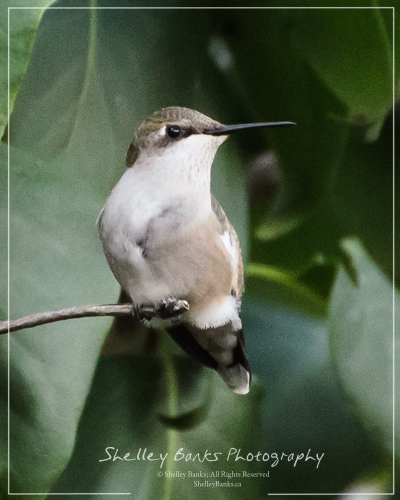
Immature Ruby-throated Hummingbird drops by: Regina, SK

Ruby-throated Hummingbird. Copyright © Shelley Banks, All Rights Reserved.
Ruby-throated Hummingbird resting in the lilac trees between feedings. © SB
I was planning to put away the hummingbird feeder when I saw a Ruby-throated Hummingbird buzz by it. So I refilled it with fresh sugar water, and have been told to continue doing so for several weeks yet. Hummingbirds may be migrating, but they are not yet gone — and there are often strays that arrive later in the fall looking for sustenance.

At first, I thought the Ruby-throated Hummingbird we saw throughout the day yesterday and the one that's been busy here today was a female, because its throat is quite pale. On a closer view, though, there are a fair number of dark speckles on her/his throat, which makes it more likely that this is an immature male...

Unless, of course, there are two birds taking turns in our yard? But I think it's just that with feather colours, so much depends on the light.

Ruby-throated Hummingbird. Copyright © Shelley Banks, All Rights Reserved.
This Ruby-throated Hummingbird has me trained - I see it, I fill the feeder.  © SB  
Ruby-throated Hummingbird. Copyright © Shelley Banks, All Rights Reserved.
I think this is the same bird - it's possible it's not, as this was taken yesterday,
and the ones above were taken today. The light was different, which affects colour. © SB
Ruby-throated Hummingbird. Copyright © Shelley Banks, All Rights Reserved.
A front view, yesterday's Ruby-throated Hummingbird, resting.  © SB
Ruby-throated Hummingbird. Copyright © Shelley Banks, All Rights Reserved.
Another look at the feathers of today's Ruby-throated Hummingbird. © SB 
  
What is this? An immature male Ruby-throated Hummingbird - Colibri à gorge rubis
Location: Backyard, Regina, Saskatchewan
Photo date: September 8, 2016.

~~~~~

Wednesday, August 24, 2016

Juvenile Chipping Sparrow: New baby bird for our Regina yard

Juvenile Chipping Sparrow. Copyright © Shelley Banks, All Rights Reserved.
Juvenile Chipping Sparrow in the garden sprinkler 
We had several new-to-us young birds this summer, including a juvenile Chipping Sparrow with fresh baby bird feathers that differ just enough from the adults' to be confusing.

For example, its trademark red cap had not yet grown in, and its breast was streaked, not pale buffy gray. But the close presence of the adult — who frequently fed it, as well — confirmed that this streaky brown baby bird really was a Chipping Sparrow.

I knew that some Chipping Sparrows stayed for the summer in parts of Regina, Saskatchewan, but this was the first time I've been aware of one nesting near my part of town.

Adult Chipping Sparrow. Copyright © Shelley Banks, All Rights Reserved.
Adult Chipping Sparrow © SB
Juvenile Chipping Sparrow. Copyright © Shelley Banks, All Rights Reserved.
Juvenile Chipping Sparrow © SB
Adult and Juvenile Chipping Sparrow. Copyright © Shelley Banks, All Rights Reserved.
Feeding time for the Chipping Sparrows © SB
Adult and Juvenile Chipping Sparrow. Copyright © Shelley Banks, All Rights Reserved.
Dependent and demanding! Chipping Sparrows. © SB
Juvenile Chipping Sparrow. Copyright © Shelley Banks, All Rights Reserved.
Brown speckled juvenile Chipping Sparrow   © SB
Adult Chipping Sparrow. Copyright © Shelley Banks, All Rights Reserved.
Adult Chipping Sparrow - no, to streaks, and yes, to a red cap. © SB 

What are these: Chipping Sparrows - an adult and a juvenile.  (Bruant familier)
Location: Backyard, Regina, Saskatchewan, Canada.
Photo dates: July 31 to August 2, 2016.

~~~~~
Related Posts Plugin for WordPress, Blogger...