Showing posts with label bird. Show all posts

Friday, November 18, 2016

Marsh Wren on a wetland cattail in the marsh

Yes, we have Marsh Wrens in Saskatchewan, but so far they don't want to pose for me. As I've been trying to learn the different kinds of wrens today, I thought I'd post a picture of a Marsh Wren anyway, taken along the Dyke Trail in Richmond, B.C.

Marsh Wren. Copyright © Shelley Banks, all rights reserved.
Marsh Wren on a cattail, in the - what else? - marsh. © SB

What is this? A Marsh Wren (Troglodyte des marais)
Location: Along the dyke, Richmond, B.C. 
Photo date: April 26, 2014 

~~~~~

Sunday, October 30, 2016

American Bittern - Make like a reed and disappear

Startle an American Bittern, and it will stretch up its neck and freeze in place — which I guess makes this bird think it's hiding, invisible to my sight... And that may work if it's deep in the reeds, though the strategy is markedly less successful if the Bittern is standing at the side of a Saskatchewan grid road, foot lifted as if to begin its agonisingly slow walk back into the marsh.

American Bittern, on Saskatchewan grid road. Copyright © Shelley Banks, all rights reserved.
American Bittern, on Saskatchewan grid road. © SB

What is this? American Bittern (Butor d'Amérique)
Location: Near Yellowgrass, Saskatchewan
Photo date: May 21, 2012.

~~~~~

Monday, October 14, 2013

Colourful Ring-Necked Pheasant on Saskatchewan Road

Ring-necked pheasants top the list of picture suggestions I receive when people find out that I take photographs of birds along rural roads, in parks, and around my backyard.

And finally, I saw one, on Seven Bridges Road to Lumsden, a small town in the Qu'Appelle Valley north of Regina, Saskatchewan. This Prairie bird was immature, and lacked the vibrant blue head and neck feathers older males sport — but its facial skin was bright red, its tail elegantly long, and its body feathers, wonderfully rusty red and gold.

Immature male Ring-necked Pheasant. Photo © Shelley Banks, all rights reserved.
Immature male Ring-necked Pheasant,
showing red face markings.  © SB

And then today, driving along the old highway north from Regina, I saw a mature male Ring-necked Pheasant, with a stunning blue, red and white head, and gorgeous body feathers. He was shy, though, and marched into the trees as soon as he saw me... Which is exactly what the younger pheasant did last month...

Male Ring-necked Pheasant. Photo © Shelley Banks, all rights reserved.
Male Ring-necked Pheasant, walking away from the camera... © SB
Immature male Ring-necked Pheasant. Photo © Shelley Banks, all rights reserved.
And here's the younger, immature male Ring-necked Pheasant, 
posing (less-than-totally helpfully) in the shade © SB

And yes, I'll keep looking for a mature male who will stand still in bright sunlight and pose for me, his feathers rainbow sparkling... (On roads and in parks, at least; unlike Gray Partridges, Pheasants are not going to appear in my suburban yard...) But for now, at least, I've got two Saskatchewan Ring-necked Pheasants. 


What are these? An immature male Ring-Necked Pheasant, and a mature male Ring-Necked Pheasant.
Location: Along Seven Bridges Road and the old highway from Regina to Lumsden, Saskatchewan 
Photo dates: September 9, 2013, and October 14, 2013. 

~~~~~

Sunday, October 13, 2013

Northern Flicker: Large Backyard Woodpecker in Regina, SK

A Northern Flicker landed on one of our bird feeders in Regina, Saskatchewan, this morning. Too big to balance on the tiny ledge, it then flew to the vines atop our backyard trellis.

This large woodpecker looks like the Yellow Shafted variety of Northern Flickers from its markings, including its bright red cap and the flash of yellow along its wings and on their undersides. This bird is also male, from the black moustache, or malar, beside its beak and beneath its eye.

Northern Flicker, © Shelley Banks, all rights reserved.
Northern Flicker in my backyard.  © SB

And yes, it's large: Northern Flickers are more than 12 inches long, with wingspans of 20 inches, says The Sibley Guide to Birds. They are also beautiful and very distinctive in flight!


What is this? A Northern Flicker
Location: Backyard, Regina, Saskatchewan, Canada
Photo date: October 13, 2013


~~~~~

Sunday, September 8, 2013

American Kestrels: Tiny Falcons in Regina

American Kestrel watches my neighborhood
from the top of a tree. © SB 
This evening, several American Kestrels flew over our Regina, Saskatchewan, house and landed on the highest tips on the neighbours trees.

At least, I thought these mighty little birds were Kestrels, based on their size and markings.

But they are difficult to see when they fly fast and far, and so it wasn't until my camera captured the proof that I believed my first identification.

Kestrels are a small falcon — and not the first falcons I've seen in Regina. (There are also Peregrine Falcons that nest on City Hall.)

These birds are also (to my eye) a gorgeous mix of black, slate blue, reddish and pale spotted feathers. But yes, they are raptors; and yes, they hunt...


Pair of American Kestrels, near Lumsden, Saskatchewan.
(The male, left, has far more blue-gray, 

than the female, right.)  © SB 
American Kestrel on a power wire.  © SB 

What are these? American Kestrels 

Location: Saskatchewan, Canada: In Regina, and near Lumsden.  
Photo date: September 8, 2013, and April 21, 2012. 

~~~~~


Thursday, August 29, 2013

Horned Larks in Prairie Dog Town, Grasslands National Park

Horned Larks and Long-billed Curlews saunter through Black-tailed Prairie Dog towns in the early morning, even before the Prairie Dogs are up and playing. (What attracts these birds? Bugs? Droppings, which lead to bugs?)

First, a clear shot of a Horned Lark on a fence post, taken along a southern Saskatchewan road last summer.

Fence post sentinel, a male Horned Lark along a rural Saskatchewan road. © SB
And, second, a shot of a Horned Lark in Grasslands National Park, perched on the entry to... Yes, a Black-tailed Prairie Dog burrow.

Standing guard - Horned Lark in the Prairie Dog town. © SB

Burrowing Owls are also among the birds drawn to these towns — they borrow old burrows as nests. 

What are these birds? Horned Larks
Location: Saskatchewan, Canada (In Grasslands National Park, and along a rural road.)
Photo date: June 29, 2012, and June 25, 2013.   Prairie Passages Tour

~~~~~

Thursday, August 8, 2013

Cedar Waxwings - with and without Wax-Tipped Wings

At times, Cedar Waxwings' red waxy wingtips seem to be missing — a young bird, perhaps — or simply difficult to see.

Although Cedar Waxwings seem unfinished without the bright identifiers that give them their name, even without them, these birds remain very distinctive, with their black masks and flying head feathers.

Here's a look at a wax-free Cedar Waxwing, and one with bright red wax on its wings.

One of a group of five or six Cedar Waxwings,
none of which sported visible wax.   © SB

Ah, much more bird-book-cliché!
A Cedar Waxwing, with waxy wings! 
© SB

What is this bird? Cedar Waxwing
Location: Near Regina, Saskatchewan. (First picture, along Seven Bridges Road near Lumsden; second, at Condie Nature Refuge.) 
Photo dates:  First, July 29, 2013; second, May 28, 2013.  

~~~~~

Thursday, August 1, 2013

Western Kingbirds: Grey and Yellow Flycatchers near Regina

Fencepost with Western Kingbird  © SB
Today, a few pictures of Western Kingbirds — attractive yellow and grey flycatchers.

At this time of year, I've taken to calling them grid road birds, because that's where I see usually Western Kingbirds in Saskatchewan.

(Yes, right on the gravel, looking for bugs. My photographs, though, show them on fences and trees, as that's where the Western Kingbirds fly when I drive by.)

The first time I noticed Western Kingbirds, I was surprised by how bright their lemony yellow bellies are. And for me, that's their most noticeable characteristic. The bird guides, though, also talk about their white tail edges — which may disappear when worn, as well as their robin-like flight, dark lores, and short, square-tipped tails.

Western Kingbird on barbed wire, showing off its white tail feathers © SB
Western Kingbird on alert, waiting for me to drive on by. © SB

What are these bird? Western Kingbirds.
Location: Around Regina, Saskatchewan, Canada  
Photo date: First photograph, July 31, 2013; second, June 29, 2012; third, July 26, 2012.

~~~~~


Monday, July 22, 2013

Loggerhead Shrike on Teepee Pole, Saskatchewan

High on a teepee pole, a Loggerhead Shrike.

At first, this small bird was on a fence post beside the road. And then (as soon as cars stopped and camera came out), it flew to the far side of the new campground in Grasslands National Park. Finally, it landed on the top of a pole, and sang.

Loggerhead Shrike on a teepee pole in Grasslands National Park, Saskatchewan, Canada

What is this bird? A Loggerhead Shrike 
Location: Grasslands National Park, near Val Marie, Saskatchewan. Prairie Passages Tour
Photo date:  July 26, 2013.

~~~~~

Monday, July 15, 2013

Lark Bunting in breeding plumage

One of my favourite Saskatchewan grassland birds is the Lark Bunting — perhaps because the males look so formally attired in their crisp black and white breeding plumage.

The female Lark Buntings are also lovely, with an intricate brown feather pattern.

These small songbirds were fairly common in the Val Marie, Saskatchewan, area during our recent Prairie Passages Tour of pastures and grasslands. Especially lovely to see, knowing that come winter, they'll change from this bright plumage to more drab brown feathers again. (And leave Saskatchewan to fly south to Mexico for the winter.)

Male Lark Bunting in breeding plumage Photo  © Shelley Banks, all rights reserved.
Male Lark Bunting in breeding plumage   © SB

What are these birds? Lark Buntings  —  male in breeding plumage.
Location: Grasslands National Park, Saskatchewan. 
Photo date:  June 26, 2013.

~~~~~

Saturday, July 6, 2013

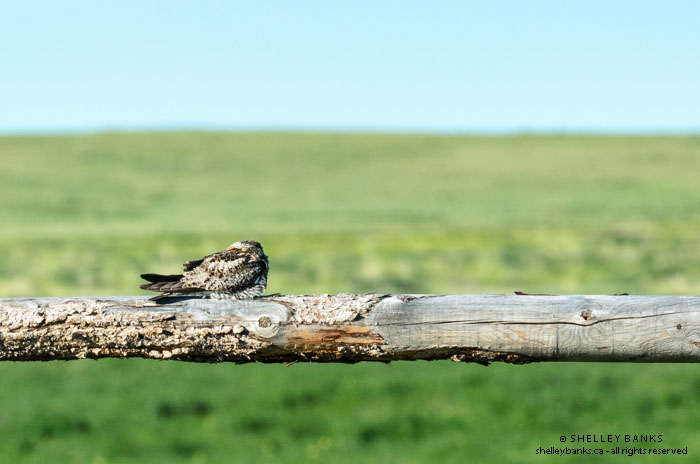
Common Nighthawks: Birds Disguised as Bark

Common Nighthawk: photograph  © Shelley Banks, all rights reserved.
Common Nighthawk: Feathers mimic bark  © SB
Now this bird is amazing: The Common Nighthawk has such intricate camouflage feather markings that once it lands, it almost disappears.

(We first saw it — but almost didn't — perched and sleeping on a fence post in Grasslands National Park, Saskatchewan.)

The camouflage works so well that All About Birds says that the insect-eating Nighthawks make no nest; with these markings, even the young are hard to find.

On our recent Prairie Passages Tour of grasslands and pastures in SW Saskatchewan, several people commented that it seemed the Val Marie, Saskatchewan, area was like a Common Nighthawk sanctuary.

They talked about seeing large groups resting on trees (which I missed...), and we saw several buzzing the early morning skies for bugs.

I was so happy when this Nighthawk was found roosting in plain view at the new GNP campground!

Common Nighthawk: photograph  © Shelley Banks, all rights reserved.
Easy to see in a close-up shot... Trickier in person, at a distance.   © SB

What is this? A Common Nighthawk
Location: Campground, Grasslands National Park, Saskatchewan.
Photo date: June 26, 2013.

~~~~~

Monday, July 1, 2013

Spotted Towhees in Grasslands: I have a message for you

To all Spotted Towhees in Grasslands National Park, Saskatchewan:

There is no need for you, or any other birds, to hide behind bare shrubby branches when I drive by.

This is the only picture I have of you large sparrows, and it barely captures your brilliant rust, white and black colouring.

Spotted Towhee beside the Frenchman River. Photograph  © Shelley Banks, all rights reserved.
Spotted Towhee beside the Frenchman River   © SB

That said, my thanks for waiting on this bush, beside a bridge over the Frenchman River, until I was able to take this single shot.

And yes, I love your bright red eyes.

Seen on the Prairie Passages tour of PFRA and other publicly owned grasslands, with conservationists, authors, and photographers, including Margaret Atwood, Graeme Gibson, Alberto Yanosky (Executive Director of BirdLife affiliate Guyra Paraguay), and  Ian Davidson (Exec. Dir., Nature Canada). Organized by Public Pastures - Public Interest. For more on the tour, see Pasture Posts and Trevor Herriot's Grass Notes.

What is this? A Spotted Towhee.
Location: Grasslands National Park, Saskatchewan.
Photo date: June 25, 2013.

~~~~~

Sunday, June 30, 2013

Rock Wren on a grasslands rock, southwest Saskatchewan


A Rock Wren — a small Western songbird  —  on southwestern Saskatchewan prairie grasslands, high above the Frenchman River.

Rock Wren. Photo copyright © Shelley Banks, All Rights Reserved.
Pale grey-brown songbird, the Rock Wren.   © SB

We listened to bison expert Wes Olson, counted wild flower species (new to me: Indian Breadroot and Clustered Broomrape), and enjoyed the dry prairie wind and sunshine.

And then birder extraordinaire Trevor Herriot spotted this Rock Wren.

On a rock, of course, with prairie grasses at the base and buttes beyond the river in the distant background.

Rock Wren. Photo copyright © Shelley Banks, All Rights Reserved.
The wind blows through the grasses above the valley,
below the rock of the Rock Wren. 
© SB
Seen on the Prairie Passages tour of PFRA and other publicly owned grasslands, with conservationists, authors, and photographers, including Margaret Atwood, Graeme Gibson, Alberto Yanosky (Executive Director of BirdLife affiliate Guyra Paraguay), and  Ian Davidson (Exec. Dir., Nature Canada). Organized by Public Pastures - Public Interest. For more on the tour, see Pasture Posts and Trevor Herriot's Grass Notes.

What is this?  A Rock Wren. 

Location: Grasslands National Park, Saskatchewan.
Photo date: June 25, 2013.  

~~~~~

Friday, June 14, 2013

Yellow-headed Blackbirds in Slough near Regina SK

Yellow-headed Blackbird. Photo ©Shelley Banks, all rights reserved.
Yellow-headed Blackbird, on reeds near Regina, SK  ©SB
Yellow-headed Blackbirds creak and dart among the reeds at a slough not far from my house in Regina, Saskatchewan.

On a recent drive, I listened to their rasping screeches and croaks, and realized that far more Yellow-headed Blackbirds were singing than I could see.

But those I could see were beautiful, their vibrant yellow, gold and amber feathers shining in the sun, their black suits, stark and sombre.

The males, that is.

The females are more subdued in colour, a blurry yellow with brown, the better to blend in the reeds and mud in the nest.

(I've only seen females in early spring — perhaps before their actual nest sitting?)

And as for a slough, that's a natural water-filled area, more shallow and reed-filled than a lake.
Yellow-headed Blackbird. Photo ©Shelley Banks, all rights reserved.
Female Yellow-headed Blackbird, in the slough  ©SB
Yellow-headed Blackbird. Photo ©Shelley Banks, all rights reserved.
Yellow-headed Blackbird ©SB

What are these?  Yellow-headed Blackbirds
Location: Slough north of Regina, Saskatchewan.
Photo date: May 25, 2012. 

~~~~~

Wednesday, May 29, 2013

Mourning Dove at Condie in a Shapely Brown Dress

I'd like a dress that flows like the back of this Mourning Dove, feather waist cinched, soft shawl collar flaring, brown narrow hips, and long long long long sleeves that go on and on and on and on...

(Edwardian? Victorian? I'm not clear on my period fashions.)

The Mourning Dove's eyes I could master with different glasses, but that's not the look that I'm going for. Green eyes, I have; googly rims, I don't need.

With this casual elegance, no need for a chair. Any old post or barbed wire will do.

Mourning Dove. Photo © Shelley Banks, all rights reserved.
A svelte and elegant Mourning Dove. © SB

What is this?  Mourning Dove
Location: Condie Nature Refuge, near Regina, Saskatchewan.

Photo dates: May 28, 2013.

~~~~~


Saturday, May 18, 2013

Baltimore Orioles in Regina: High in Wascana Park Trees

Baltimore Oriole. Photo © Shelley Banks, all rights reserved.
Baltimore Oriole near the tree top. © SB 
High in Regina trees near sunset last night, I saw five Baltimore Orioles — four males, one female.

(Perhaps there were more female Baltimore Orioles, but they are not as easy to see, being a soft yellow rather than the fiery torch orange of the males — a colour that's even brighter in red sun rays.)

I was at Wascana Park, Regina, Saskatchewan, in and around the bird pond by the Conexus Arts Centre, and what a gathering of birds!

Canada Geese, Double-crested Cormorants, Eastern and Western Kingbirds, Robins, a Brown Thrasher, three kinds of Warblers (Yellow, Yellow-rumped and Orange-crested), various sparrow and lots of Red-winged Blackbirds.

But the Baltimore Orioles were my favourite, live energy glowing and crackling at the tops of the tree! I love that orange flash!

Baltimore Oriole. Photo © Shelley Banks, all rights reserved.
Baltimore Oriole feeding
on (insects in?) old leaves. © SB 
Baltimore Oriole. Photo © Shelley Banks, all rights reserved.
Baltimore Oriole - male. © SB 
Baltimore Oriole. Photo © Shelley Banks, all rights reserved.
Baltimore Oriole - female.  © SB 

A reader posted to say that these birds are called Northern Orioles... Perhaps in some places, but recent printings of my guides continue to use the name, Baltimore Orioles. 

Cornell's All About Birds has this to say:
"The Baltimore Oriole hybridizes extensively with the Bullock's Oriole where their ranges overlap in the Great Plains. The two species were considered the same for a while and called the Northern Oriole, but in the 1990s, after genetic studies, they were separated again."
So, Baltimore Oriole is the name I'm using here. 


What are there? Baltimore Orioles
Location: Wascana Park, Regina, Saskatchewan, Canada.  

Photo date: May 18, 2013.

~~~~~

Saturday, May 11, 2013

Pine Siskin in my backyard: Regina, Saskatchewan

A Pine Siskin showed up at my backyard bird feeder in Regina, Saskatchewan, today. It sat with a red House Finch — and their apparent congeniality led me, at first glance, to think the Siskin must be a female finch...

But yellow-tipped wing and tail feathers were wrong — and so was that beak. (Pine Siskins have narrower, more delicate beaks than House Finches.) A search through finch-like birds in The Sibley Guide led me to the Pine Siskin page, and there it was — my bird feeder bird of the day: A Pine Siskin.

Pine Siskin. photo © Shelley Banks, all rights reserved.
Pine Siskin - note the yellow feathers on wings and tail, 
and clear light wing streaks. © SB
Sibley says these birds are mainly found in open coniferous forests, which does not in the least describe my suburban, flat land, backyard! So this Siskin must be passing through, to parts further north and more conifer-filled. 

In backyard bird photography, the stakes always increase. My challenge now is to photograph a Pine Siskin with sunlight sparkling in its dark eyes. (And yes! I did! And posted the Pine Siksin's lovely colours here, in 2015.)  

Pine Siskin. photo © Shelley Banks, all rights reserved.
Eye reflection, check!
Pine Siskin on Finch feeder. 
© SB


Next, with its feathers open, to display those lovely yellow wing bars! 


What is this? A Pine Siskin.
Location: Backyard, Regina, Saskatchewan, Canada.  

Photo date: May 11, 2013.

~~~~~

Thursday, April 25, 2013

Peregrine Falcon on Regina City Hall

High on a ledge at Regina City Hall, there is a Peregrine Falcon. The falcon likes the east side of the building, birders say, and it's sometimes seen near the south-east corner.

Although falcons aren't huge birds, this one was fairly easy to spot... I'd heard it was often at City Hall, and I saw it from several blocks away. (Then again, at about 16 inches, with a wingspan of about 40 inches, they aren't small birds, either!)

Peregrine Falcon on the east side of Regina City Hall.   © SB

Peregrine Falcons are birds of prey, hunting "mainly medium-size birds from high above in spectacular swoops," my Sibley guide says.

Pigeons — and robins — beware...

High, high - yes, almost near the roof
and sky in this urban canyon. 
© SB

For those who know Regina City Hall, the picture above shows the falcon's position on the ledge. And, for those who don't, this total building shot (taken a couple of weeks ago at the Mayor's Poetry City Challenge), shows the scale — although to see the falcon yesterday, you'd have had to walk around the corner to the east side. 
Regina City Hall. Walk around to the right,
towards the rest of downtown, to see the falcon.
(If, that is, it's there...)  
© SB
For more, the CBC last year aired a video interview about on falcons at City Hall with a bird watcher and with ornithologist, Dr. Stuart Houston.


What is this? Peregrine Falcon
Location: Downtown Regina, Saskatchewan, Canada.  
Photo date: April 24, 2013.

~~~~~

Thursday, April 18, 2013

First Robin Near Regina - Finally Spring!

I finally saw my first American Robin of the year in the Qu'Appelle Valley near Regina, Saskatchewan. (I'd heard rumours of these birds in various part of the city, but they still haven't come near my backyard.)

And so, I present: Robin on a wire fence.

American Robin. Photo © Shelley Banks, all rights reserved.
Beneath the robin, snow. Behind the robin, snow...   © SB

There's something about their beady stare that makes me nervous around robins...

Or, perhaps I feel that way because I have some past history with these birds. Back when I lived in Montreal, one of the local robins became an attack bird with only one target: Me. And these are birds with very long memories...

Still, it's lovely to see robins return. It must really be (almost) spring.


What is this? American Robin.
Location: Near Craven, Saskatchewan, Canada.  
Photo date: April 13, 2013.

~~~~~

Saturday, July 28, 2012

Turkey Vulture on High-Flying Carcass Hunt

A Turkey Vulture soared over the Qu'Appelle Valley ahead of me as I drove down Route 99 from Highway 6 towards Craven, Saskatchewan.

This bird, a huge, high raptor, was noticeable for the size of its wingspan — and its small beak and head. (Turkey Vultures' heads, of course, are featherless and red — but I couldn't see that from the ground, nor is the colour highly visible in the photos I took.) 


Turkey Vulture on high-flying hunt © SB

I was surprised by how beautiful the Turkey Vulture was from far below, its under-feathers frilly and light in flight. 

This scavenger spun high on thermals over the valley, and then — on the scent of a carcass? — dove into the hills below.

(And the Turkey Vulture's protective-shield effect continues; this is the second vulture I've seen in the valley, and I haven't yet managed a sharp, noise-free shot.)  

eta: Finally! Some great shots of Turkey Vultures! 


What is this bird? Turkey Vulture
Location: Qu'Appelle Valley, along Rte 99 (west of Highway 6), Saskatchewan.
Photo date:  July 26, 2012.

~~~~~

Related Posts Plugin for WordPress, Blogger...