Showing posts with label blue. Show all posts

Friday, June 21, 2013

Blue-winged Teal: White mask, blue wings

Blue-winged Teals. Photo © Shelley Banks, all rights reserved.
A pair of Blue-winged Teals   © SB
Long after I learned to identify Blue-winged Teals by the white half-mask across the male's face, I finally saw blue wing flashes on these prairie ducks.

The blue is visible when they fly — as long as you're at the right angle to see it...

It's also visible at times (but not, to me, often) when Blue-winged Teals float and feed in their preferred shallow, marshy ponds.

The first photograph above shows a clear sideview of a male's blue and green wing markings; the one below also shows the blue on a female's wing.

Blue-winged Teals. Photo © Shelley Banks, all rights reserved.
A pair of Blue-winged Teals, with blue wing flashes showing. © SB

What are these?  Blue-winged Teals
Location: Along Rte 99, near Craven, Saskatchewan, and near Yellowgrass, Saskatchewan.
Photo date: May 25, 2013, and June 16, 2012. 

~~~~~

Thursday, April 4, 2013

Mountain Bluebirds: Brilliant flashes of Saskatchewan sky

Mountain Bluebird on nestbox  Photo © Shelley Banks, all rights reserved.
Mountain Bluebird on nestbox - I hope he stays! © SB
Dozens of sky-blue Mountain Bluebirds rose
from the grass and bushes along the side of Route 99 east of Craven, Saskatchewan, yesterday.

A single brilliant male. A group of perhaps three pairs. A flock of 13 — that I counted. More...

Will these lovely birds nest in the many boxes on the road, or are they moving through?

I hope they stay. To see so many Mountain Bluebirds in one small stretch along the Qu'Appelle Valley, so close to Regina, was a total enchantment.

Sky blue. That's what I've read in bird books about Mountain Bluebirds.

And it's true, as long as you see the sky ranging from pale aquamarine to deepest sapphire, with glints of iridescence.

These birds are not a gentle baby blue; their feather flash, reflect the light.

Flying jewels, impossibly, brilliantly blue.

And yet, at the same time, easy to miss or to ignore.

The two cars that passed me on that (at times) quiet road buzzed by in a cloud of dust, their drivers oblivious to the tiny beauties on the valley fence posts, grasses, trees.

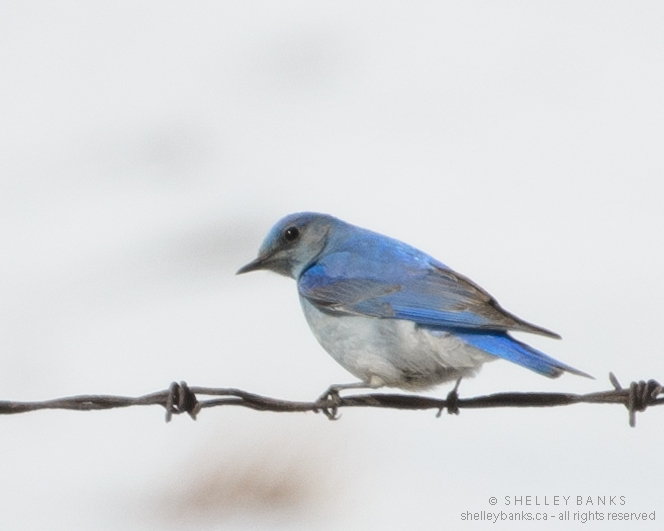
Female Mountain Bluebird on a wire - softer, grayer. Photo © Shelley Banks, all rights reserved.
Female Mountain Bluebird on a wire - softer, grayer.  © SB
Fence post Mountain Bluebird, #1, male. Photo © Shelley Banks, all rights reserved.
Fence post Mountain Bluebird, #1, male. © SB
Fence post Mountain Bluebird, #2, male. Photo © Shelley Banks, all rights reserved.
Fence post Mountain Bluebird, #2, male. © SB 

What are these? Mountain Bluebirds.   
Location: Along Rte 99, not far east of Craven, Saskatchewan, Canada.   
Photo date: April 3, 2013. 

~~~~~

Saturday, September 15, 2012

Mourning Cloak Butterfly: Maroon and Blue Shimmer

Mourning Cloak Butterfly   © SB
Mourning Cloak Butterflies are common across Canada, but I never noticed them until this week when two Mourning Cloaks came to my attention.

The first, I saw and took pictures of in Kananaskis, Alberta, when I was getting a mountain break from the prairies; the second — which led to my butterfly's ID — a friend recognized and photographed outside her cabin near Regina, Saskatchewan. (Thanks, Donna!)

Mourning Cloak Butterflies are large, with a wingspan up to eight centimetres. And although they may look black at first glance, in good light, their wings shimmer maroon or purple brown, with iridescent blue spots and a ragged butter-yellow border.

This butterfly's common name refers to, yes, a mourning cloak — a garment apparently worn by someone, somewhere (perhaps in Scandinavia?), during a time of bereavement... (The only example I've so far found online was designed to honour the butterfly — thus raising the question, which came first? The butterfly, or the cloak?)

They appear to be native to North America, and unlike Monarchs, which migrate, Mourning Cloaks hibernate  —  or, as the Manitoba site NatureNorth.com says, "spend the winter in 'cryo-preservation.'"

Where I live, in Regina, Saskatchewan, they are considered common pests. (Who knew?) Mourning Cloaks are the first butterflies to appear in this prairie city in spring, and — in sufficient numbers — the larvae are said to defoliate branches.

(The City of Regina suggests removing the larvae by hand, or leaving them to birds and wasps to devour. Yum... The nearby US state of Montana is perhaps friendlier to Mourning Cloaks, and has designated them its official butterfly.)

Pest or mascot, Mourning Cloaks are unmistakably beautiful. 


What is this? Mourning Cloak Butterfly (Nymphalis antiopa; in the UK, Camberwell Beauty)
Location: Common across Canada, including the prairies; photographed in Kananaskis, Alberta. 
Photo date: September 9, 2012. 
~~~~~


Tuesday, July 17, 2012

Belted Kingfishers near Regina, Saskatchewan

Belted Kingfisher, near Regina, SK © SB
I saw this Belted Kingfisher in early spring.

I was impressed by its colours and perky, aggressively cartoon-like head feathers and long narrow bill...

And I thought, 'Surely I'll see more of these birds on the prairie, as spring moves to summer in Saskatchewan.'

But I did not.

And so, to prove to myself that I saw a Belted Kingfisher near my home, here is my little bird — in a very tiny crop  photographed from a great distance away at the Condie Nature Refuge, north of Regina, Saskatchewan. 

Belted Kingfisher at Condie Nature Refuge © SB

What is this bird? Belted Kingfisher
Location: Condie Nature Refuge, North of Regina, Saskatchewan.
Photo date: April 21, 2012.  

~~~~~

Sunday, July 1, 2012

Blue Damselflies in the Garden

Glowing brown eyes of a blue damselfly © SB
Blue damselflies have arrived in my Regina backyard, feeding on (something in?) the grass and oregano.

I managed to get a couple of pictures of these quickly flitting — and very tiny (so difficult to focus)  insects. 

There are many kinds of damselflies. This, I know, because I have a copy of Dragonflies and Damselflies in the Hand. (Hutchings and Halstead, Nature Saskatchewan.)

And that book's focus is Saskatchewan's Boreal Forest, for which it lists at least nine kinds of damselflies; who knows how many others are here in the south of the province, on the Prairie? 

Well, someone no doubt does   just not me.

So when I write, Blue, please understand that I mean Blue in its most generic, colour-descriptive sense. Because these are  Blue

Except for their oddly yellow-brown eyes. 

Blue damselfly on grass blade © SB  


What are these?  Blue damselflies   
Location: Backyard, Regina, Saskatchewan, Canada.
Photo date: June 28, 2012.  

~~~~~

Related Posts Plugin for WordPress, Blogger...