Thursday, October 10, 2013

Home on the Range on the Alberta/Saskatchewan Border

Today, driving through and beyond Cypress Hill Inter-Provincial Park (we were on the Alberta side, but the park is in Saskatchewan, too), we came across this classic Home on the Range scene:

Horses. White. Brown. Black. White and black. By a watering hole in dry grasses, among gently rolling hills... No, merely gently rolling rises of land.

Horses on the Canadian Prairies © Shelley Banks, all rights reserved.
Home on the Range... Horses on the Canadian Prairies © SB

What is this? A scene with horses grazing on a ranch by a lake in Southern Alberta, under heavy skies... along the Saskatchewan border. 
Location: Near the edge of the West Block, Cypress Hills Inter-Provincial Park (Alberta and Saskatchewan) .
Photo date: October 10, 2013.
~~~~~

Monday, October 7, 2013

Pronghorn Antelopes: Saskatchewan's TransCanada Highway

Pronghorn Antelope © Shelley Banks 2103. all rights reserved
Mature male Pronghorn Antelope beside the TransCanada Highway. © SB
West of Swift Current, Saskatchewan, yesterday, we saw more than two dozen Pronghorn Antelope along the TransCanada Highway.

These very fast moving (up to 100 km/hour) mammals have excellent camouflage — tan fur against tan grasses.

And they can be elusive.

Sometimes, a drive west from Regina along the TransCanada yields sightings of several; sometimes, none.

The Pronghorn is a native North American animal, evolving from other mammals that have been here more than 25 million years. (Now that is a long time! And my source is The Encyclopedia of Saskatchewan, whose researchers have a much better sense of long time than me.)

And so Pronghorn Antelopes are one-of-a-kind, the only surviving members of their family.

Fall is said to be a good time to see them (when the herds gather). I was hoping for great antelope encounters on our drive — and was not disappointed.

The first group of Pronghorn Antelopes were far away on a rise of land, and the third and fourth groups were only distant white and brown specks... But the second group of five of these wonderful, wild Prairie animals was clear, bright and alert, and fairly close to the highway.

Pronghorn Antelope © Shelley Banks 2103. all rights reserved
Young male Pronghorn Antelope, with stubs of horns. © SB
Pronghorn Antelope © Shelley Banks 2103. all rights reserved
Distant Pronghorn Antelope, on a Prairie bluff.   © SB

What are these? Pronghorn Antelope. 
Location: West of Swift Current, Saskatchewan.
Photo date: October 6, 2013.

~~~~~

Thursday, October 3, 2013

Northern Lights above Regina, SK: October 1, 2013

Northern Lights © 2013, Shelley Banks, all rights reserved.
Looking south at Regina's orange tungsten glow,
 past grain bins and a field...
with Aurora Borealis sheeting through the sky above. © SB 
Yes, you can see Northern Lights in Regina! Links within this story go to other Aurora Borealis photos taken in Saskatchewan. 

The winter 2013-14 Aurora Borealis season began in Regina, Saskatchewan with a stunning display late evening on October 1, with northern lights arcing across the entire bowl of the sky... Lights so bright we stood in awe in the backyard to watch...

And then we realized we'd see these Northern Lights even better outside of town, beyond the orange glare of tungsten street lights. But it was late, and among us in the car were very early risers... And the lights had already begun to fade. So when we found a turnoff to a field a short way from the city (not as dark as our usual spot), we pulled over.

Magnificent! (See end for technical details, re: photographing northern lights.) 

The Aurora Borealis was so bright that even full-on headlights from passing pick-up trucks didn't dim the show. Mega-bright.

This was a major storm for us — for anywhere, in fact.

(Canada's national Space Weather site ranked this as a bright red 9, top of the scale for the Southern Prairies region. And AuroraWatch.ca suggested an at least 96 per cent chance of seeing the Auroras... If the sky was clear... And it was!)

Since I've moved to the Prairies and started watching for Northern Lights, I've been in awe of the fact that the stars remain so visible behind the streaks. The Aurora often looks like a cloud, a coloured mistiness that washes across the sky. And clouds — but not these lights! — block stars from view.

Look closely at this picture below... On the left half, you can see (brightly sparkling) the stars that comprise Ursa Major — not just the Big Dipper, but all of the bear, from its head through legs, missing only the tip of its tail. Above, is Ursa Minor, with a twist of Draco between these two bears. On the bottom right, Auriga, the chariot or chariotteer, with the hero Perseus in the cluster of stars above. (We are so lucky to have semi-dark skies here!)

Northern Lights © 2013, Shelley Banks, all rights reserved.
Yes, there are clouds in this picture - there is a low, thin bank, at the very bottom left.
The rest of the sky is crystal clear, with pale green and soft pink Northern Lights. 
© SB

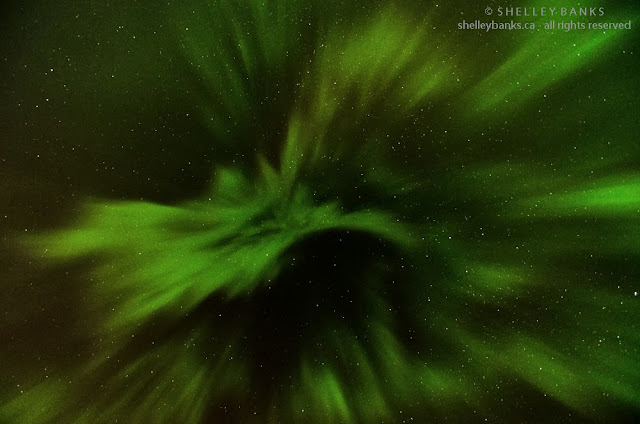
I am always enchanted when these magical displays splash out from the top of the bowl of the sky, and from there, sheet down to the horizon. Many displays are limited to just the northern horizon, so these full-sky shows are a treat. Below are two shots taken with the camera set to face straight up, to capture whatever was happening during these three-second exposures.


Northern Lights © 2013, Shelley Banks, all rights reserved.
Northern Lights across the bowl of the sky...
This looks like an eagle's head/beak in the centre, to me! 
© SB

Northern Lights © 2013, Shelley Banks, all rights reserved.
Again, the Northern Lights explode from the centre of the sky. © SB 

The Big Dipper/Ursa Major is clear in the northern part of our skies at this time of year, and in the image below, you can see it above the lights of a distant farmyard, as the Aurora Borealis sheets above and across the sky. (Draco and Ursa Minor are pretty clear, there, too.)


Northern Lights © 2013, Shelley Banks, all rights reserved.
Aurora Borealis falls in waves across the sky, above fields a few minutes north of Regina, Saskatchewan.
Note the Big Dipper, clear above the distant farm complex. 
© SB 

And the next image looks straight west, showing how much stronger the lights were in the Northern half of the sky...


Northern Lights © 2013, Shelley Banks, all rights reserved.
The lights were slow moving, but at times seemed to fall like rain. This image was taken facing west (with north at right).
The power poles from the grid road can be seen tipping (wide angle distortion) gently rightward,
while lights of an oncoming car glow brightly down the road. 
© SB 

At one point, a car pulled out of the field across the road, lighting the field where we were parked, watching the show. Its full-on lights provided unexpectedly great lighting for the portrait I had in progress... I'd thought I'd have to retake because of its effect on my timed exposure, but it was fine! (And besides, everyone was cold by then, and wanted to go home, and my model was the early riser with the 6 a.m. shift...) You can see that shot (soon!) on my Photography blog.

Technical details, re: Photographing Northern Lights:

  • All photographs were taken using a tripod and remote; all with my Tokina DX 11-16mm f/2.8 lens (the older version, which is an excellent match with my Nikon D7000 for night sky photography); 
  • All at f/2.8 and ISO 800, with a shutter speed of three seconds, to capture the most light. (So yes, pictures of Northern Lights will be often be brighter than what our eyes see, because the lens stays open longer... and, yes, photographers may tweak the white or highlights a bit...) 
  • All at 11 mm, though some were later cropped to removed distractions and distortions. (My camera has a cropped sensor, so that's somewhat akin to 16 mm on a full frame.) 
  • I left the white balance at Auto, though Daylight is often recommended. (In post-production, Daylight's temperature at 5500 was too green, so I reset to 5200 from Auto's 5050...) 
  • I also removed the lens filter, as I've read that can create distortion... I've no idea if that's really the case! 
  • These Aurora Borealis weren't moving quickly; if they had been, I'd have raised the ISO a few stops for a faster shutter speed. (1.6 seconds at 1600 ISO would allow the sensor to capture the same amount of light, for a slightly grainier image.) 
  • I don't have a flashlight with a red lamp, but used my iPhone to see the camera setting when I played with adjustments. Not its flashlight, but the glow from the dim phone screen. 
  • The camera was on Manual focus, set to Infinity — except for the portraits I tried, one of which is on my photo blog. The focus setting for that was a bit more complicated! (See my notes with the portrait, re: setting the focus in the dark.) 
I'd welcome comments from other photographers who've shot the Northern Lights, re: your approach and settings! 


What are these? Aurora Borealis, or Northern Lights. (The links above go to other pix taken in Regina.)
Location: Slightly beyond the city lights of Regina, Saskatchewan, in a field just out of town.
Photo date: October 1, 2013.

~~~~~

Sunday, September 8, 2013

American Kestrels: Tiny Falcons in Regina

American Kestrel watches my neighborhood
from the top of a tree. © SB 
This evening, several American Kestrels flew over our Regina, Saskatchewan, house and landed on the highest tips on the neighbours trees.

At least, I thought these mighty little birds were Kestrels, based on their size and markings.

But they are difficult to see when they fly fast and far, and so it wasn't until my camera captured the proof that I believed my first identification.

Kestrels are a small falcon — and not the first falcons I've seen in Regina. (There are also Peregrine Falcons that nest on City Hall.)

These birds are also (to my eye) a gorgeous mix of black, slate blue, reddish and pale spotted feathers. But yes, they are raptors; and yes, they hunt...


Pair of American Kestrels, near Lumsden, Saskatchewan.
(The male, left, has far more blue-gray, 

than the female, right.)  © SB 
American Kestrel on a power wire.  © SB 

What are these? American Kestrels 

Location: Saskatchewan, Canada: In Regina, and near Lumsden.  
Photo date: September 8, 2013, and April 21, 2012. 

~~~~~


Thursday, August 29, 2013

Horned Larks in Prairie Dog Town, Grasslands National Park

Horned Larks and Long-billed Curlews saunter through Black-tailed Prairie Dog towns in the early morning, even before the Prairie Dogs are up and playing. (What attracts these birds? Bugs? Droppings, which lead to bugs?)

First, a clear shot of a Horned Lark on a fence post, taken along a southern Saskatchewan road last summer.

Fence post sentinel, a male Horned Lark along a rural Saskatchewan road. © SB
And, second, a shot of a Horned Lark in Grasslands National Park, perched on the entry to... Yes, a Black-tailed Prairie Dog burrow.

Standing guard - Horned Lark in the Prairie Dog town. © SB

Burrowing Owls are also among the birds drawn to these towns — they borrow old burrows as nests. 

What are these birds? Horned Larks
Location: Saskatchewan, Canada (In Grasslands National Park, and along a rural road.)
Photo date: June 29, 2012, and June 25, 2013.   Prairie Passages Tour

~~~~~

Wednesday, August 21, 2013

Western Willet in Grasslands National Park

This Western Willet chose a roadside slough as its nesting place in Grasslands National Park, and each time we turned that corner, we watched for it — or its fledging offspring — on the gravel.

This mottled shorebird breeds mainly in inland areas in the Prairies and Mid West, then winters along the coasts of North and South America. Though fairly dull on land, in flight, Western Willets have a stunningly bold black and white wing pattern, which (I hope) one day I will (I hope) capture... (And yes! Click the link!)  But birds in flight can be little trickier than one standing on a rock...

Western Willet. © Shelley Banks, 2013, all rights reserved.
Western Willet watching us, and watching its young fledgling. © SB 
Young Western Willet. © Shelley Banks, 2013, all rights reserved.
Fledgling Western Willet, hiding in the grass. Gotta love camouflage. © SB 

What are these birds? An adult and a young Western Willet - Chevalier semipalmé
Location: Grasslands National Park, Saskatchewan, Canada Prairie Passages Tour
Photo date: June 26, 2013. 

~~~~~

Tuesday, August 13, 2013

Cedar Waxwing Courting Ritual: Pass the Insect

It's my bug, but if you love me,
you can have it... © SB
I recently saw several Cedar Waxwings near Regina, Saskatchewan, which reminded me of a courting ritual I saw this spring...

Pass the Insect.

The ritual began when a Cedar Waxwing with a bug in its beak attracted the attention of a second Cedar Waxwing, which flew down to land on the branch beside it.

The two birds then proceeded to pass the bug back and forth for several minutes until (I think) one of them ate it. All About Birds says they'll do the same with other small items, such as fruit or petals. 

Copyright (c) Shelley Banks; all rights reserved.
Birds in Motion! Cedar Waxwings courting/feeding in an endless loop.. 
And now, in slo-mo...

The bug lure is working... The second Cedar Waxwing is landing... © SB
The bug changes beaks. © SB
Um, yum! A bug - Cedar Waxwing love. © SB
Time to share the bug love again. © SB
Back to the beginning. Start again. © SB


What are these bird? Cedar Waxwings.
Location: Condie Nature Refuge, near Regina, Saskatchewan, Canada  
Photo date: May 28, 2012.

~~~~~

Thursday, August 8, 2013

Cedar Waxwings - with and without Wax-Tipped Wings

At times, Cedar Waxwings' red waxy wingtips seem to be missing — a young bird, perhaps — or simply difficult to see.

Although Cedar Waxwings seem unfinished without the bright identifiers that give them their name, even without them, these birds remain very distinctive, with their black masks and flying head feathers.

Here's a look at a wax-free Cedar Waxwing, and one with bright red wax on its wings.

One of a group of five or six Cedar Waxwings,
none of which sported visible wax.   © SB

Ah, much more bird-book-cliché!
A Cedar Waxwing, with waxy wings! 
© SB

What is this bird? Cedar Waxwing
Location: Near Regina, Saskatchewan. (First picture, along Seven Bridges Road near Lumsden; second, at Condie Nature Refuge.) 
Photo dates:  First, July 29, 2013; second, May 28, 2013.  

~~~~~

Monday, August 5, 2013

Baird's Sparrow in Grasslands National Park

Far off in bushes at the edge of the grasses, a rare and elusive Baird's Sparrow...

Towards the left, the Baird's Sparrow © SB

What is this bird? A Baird's Sparrow 
Location: Grasslands National Park, near Val Marie, Saskatchewan. Prairie Passages Tour
Photo date:  June 26, 2013.

~~~~~

Thursday, August 1, 2013

Western Kingbirds: Grey and Yellow Flycatchers near Regina

Fencepost with Western Kingbird  © SB
Today, a few pictures of Western Kingbirds — attractive yellow and grey flycatchers.

At this time of year, I've taken to calling them grid road birds, because that's where I see usually Western Kingbirds in Saskatchewan.

(Yes, right on the gravel, looking for bugs. My photographs, though, show them on fences and trees, as that's where the Western Kingbirds fly when I drive by.)

The first time I noticed Western Kingbirds, I was surprised by how bright their lemony yellow bellies are. And for me, that's their most noticeable characteristic. The bird guides, though, also talk about their white tail edges — which may disappear when worn, as well as their robin-like flight, dark lores, and short, square-tipped tails.

Western Kingbird on barbed wire, showing off its white tail feathers © SB
Western Kingbird on alert, waiting for me to drive on by. © SB

What are these bird? Western Kingbirds.
Location: Around Regina, Saskatchewan, Canada  
Photo date: First photograph, July 31, 2013; second, June 29, 2012; third, July 26, 2012.

~~~~~


Related Posts Plugin for WordPress, Blogger...